Cisco Unified Edge with Nutanix - Official Release!
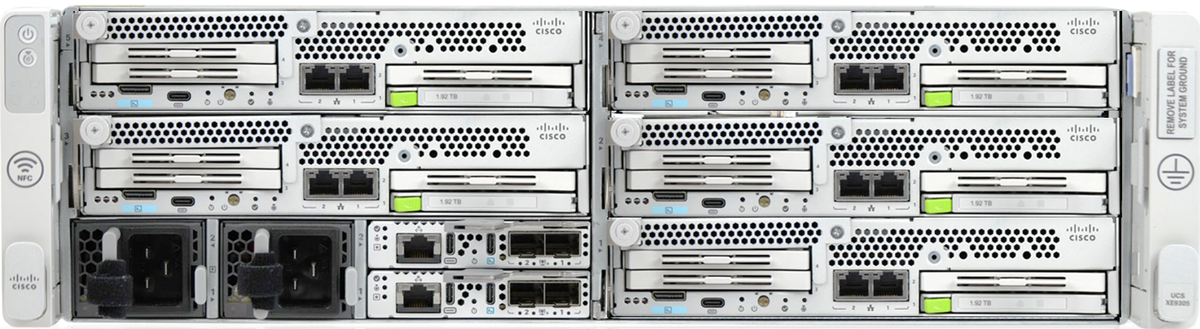
In the unofficial Part 1 of the "Edge" series, I wrote about Cisco's UCS X-Series Direct for small/medium edge sites. In Part 2 I wrote about expanding beyond a single chassis with multi-chassis X-Series Direct support for large to extra large edge sites. Now?
CISCO UNIFIED EDGE SUPPORT WITH NUTANIX AHV/AOS!

That's right! Cisco's Unified Edge platform is now officially supported with Nutanix! The solution addresses extra small to small edge workloads while packing quite the punch.
The Unified Edge hardware from Cisco has been released to the public since November, 2025 but the question that the market kept asking was: "When will support for Nutanix come?", however, that wasn't quite the right question. Nutanix has a broad software portfolio and the answer back then was, technically, now ...
I wrote about this shortly after the hardware was unveiled to the world where I mentioned that Unified Edge was unveiled and that Cisco did have plans to support Nutanix, but the focus was more or less on the Nutanix Kubernetes Platform (NKP) and that NKP was supported (which turned to be about a month later than I had posted). While NKP is a great solution from Nutanix, so much so that Cisco even wrote a CVD around Unified Edge and NKP, the question customers were truly asking was a bit more specific:
"When will Nutanix AHV/AOS be supported with Cisco Unified Edge?"
Wait no longer - IT'S HERE!
Cisco Unified Edge: Nutanix AHV/AOS
Cisco and Nutanix have been hard at work making this solution available to customers. The HCI hardware configurations were made orderable some time ago. You can find the data sheet here and the spec sheet here. But the key piece that's been missing has been the Nutanix software, which is now officially released.
This is a big deal. A really big one. It gives customers a truly viable option for highly distributed environments or edge sites that don't require much compute while providing an enterprise grade solution. One could argue this segment of the market has been ignored by most vendors but the timing for Cisco and Nutanix couldn't be more perfect with all the Broadcom disruptions and AI efforts (there, I said it, AI, AI, AI, get off my back).
Let's revisit the chassis.
Cisco Unified Edge Hardware
For what it's worth - I won't be but scratching the surface of what this platform can do. I mentioned this the first time I wrote about it. This platform was engineered from the ground up and lots of lesson's learned over the years were applied into its design.
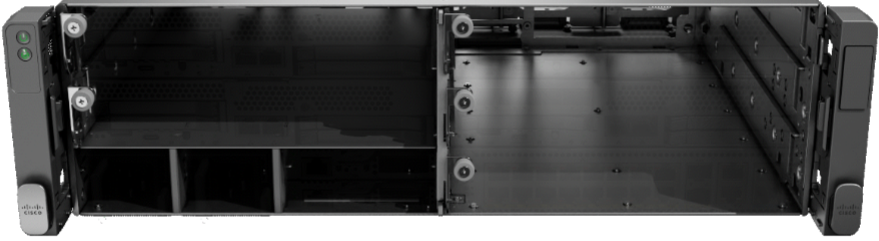
The above image shows an empty chassis. By itself a few things should immediately jump out:
- It is a highly modular platform
- The chassis itself is more or less dumb sheet metal (this is a good thing)
- It's not very big (3 Rack Units [3.75"] and I know you can't see this but ...)
- The chassis has a depth of 18"
What may not be as obvious from the empty chassis is what it can actually do:
- The chassis can be mounted / stored in many different configurations which include:
- Two (2) or four (4) post rack
- Wall mounted
- Horizontally and Vertically (Desktop-like configuration)
- Yes, someone can work next to these servers. No, they won't go deaf.
- Has a wide temperature operating range; 5 degrees Celsius to 45 degrees Celsius aka 41 degrees Fahrenheit to 113 degrees Fahrenheit (for you Americans.)
- Optional security bezel that can also fit an air filter for those really remote and dirty locations.
- Fans accessible from the top or rear of the chassis for ease of replacement
- And the list goes on
That's just chassis type tech specs - so what is Cisco supporting with Nutanix AHV/AOS?
Unified Edge with Nutanix
First let's talk about the architecture. Coming out of the gates, Cisco and Nutanix are only supporting the Hyperconverged Infrastructure (HCI) architecture. This means that this platform cannot be used as Compute Only (CO) nodes. FlashStack with Nutanix and soon to be FlexPod with Nutanix are not supported. This is perhaps subject to change but don't hold me to this. If you were to go down the CO+External storage path, why use Unified Edge? Why not either regular rackmount servers or UCS X-Series Direct?
Second an HCI cluster can support anywhere from a single (1) node all the way up to a fully populated chassis of five (5) nodes. It is worth noting that a Nutanix cluster with Cisco Unified Edge is currently bound to a single chassis. Whether this changes in the future or not is unknown but a customer needing more than a single chassis and more than five (5) nodes worth of compute/storage resources cannot introduce a second Unified Edge chassis to expand the existing cluster. Plan ahead and make the right platform decision.
Each Unified Edge with Nutanix node can be configured with the following specs:
- Two (2) - Four (4) NVMe E3.S drives
- From 1.9TB all the way to 15.3TB
- Single socket Intel Granite Rapids CPU
- Options of 20 cores and 32 cores
- Up to 768GB of RAM
- A single NVIDIA L4 GPU (here's your AI story)
- And deserving of a couple paragraphs, the network (more on this below)
Cisco Unified Edge with Nutanix Chassis/Node Configurations
Third - the networking! I'm not talking about a specific network module that may or may not be released in the future. I'm talking about the internal networking to the chassis and essentially, the Nutanix storage CVM traffic. Even though I shouldn't have to remind anyone, I will. High bandwidth, low latency networking is pretty important with Nutanix (and HCI in general).
Cisco's Unified Edge platform servers comes with two (2) integrated 25Gbps connected NICs per server. These interfaces are used by the Nutanix Controller Virtual Machines (CVMs) for all storage replication/resiliency traffic and any VM to VM communication (assuming same VLAN). This allows customers to spend less for the top-of-rack network switches (that's a weird thing to say for Cisco) at the edge while keeping a highly available and high bandwidth network internal to the chassis.
The server NICs are connected into a backplane for interconnecting all the servers in the chassis, which is controlled by a pair of what's called "eCMC" or Edge Chassis Management Controller.
Worth nothing that the internal networking is strictly Layer 2 (L2) but this works great for Nutanix and the storage traffic. Let's take a look at what this looks like between Nutanix CVMs with Cisco's Unified Edge platform.
Cisco Unified Edge with Nutanix CVM Traffic
Fourth, and not last, or least, is how the solution is deployed and managed. If you've heard any Cisco folks talk about Unified Edge, you probably heard them say "Fleet Management" and/or "Blueprints". You can look that up if you want - I'm not going to go into those features because, at least at the time of writing, these Unified Edge features are not supported with Nutanix and quite honestly, that's ok (at least for now). Cisco and Nutanix have already worked out automated deployments.
How an end user deploys these is through the already well established process using Nutanix's Foundation Central Appliance version 2.2 and Cisco Intersight for profile/policy creation and management. The version and form factor mentioned above is actually pretty important so mark it down and don't use anything else, otherwise the installation will fail. Stay tuned as Cisco does plan to release the install guide which you will be able to find here once it is released.
Use Cases & Industries
It's hard to talk about all the tech specs and not provide where Cisco sees this platform play. I've included a list below to get the "outside the box" juices flowing but these are definitely not all inclusive. As the platform continues to evolve and engineering teams develop different features and functions, the list will grow.
Use Cases:
- IoT Endpoints that generate data
- Smart devices and smart sensors
- Server closet / remote sites / remote branches
- Bringing compute closer to the data generation (IE - Don't send data to cloud or main data center, process it locally)
- AI at the edge (did you see those GPUs??)
- Lower latency needs at the edge
- Data sovereignty needs
Industries:
- Retail
- Financial Services
- Manufacturing
- Healthcare
- Utilities
And the list goes on ... and on ... and on.
As I mentioned at the beginning, I am only scratching the surface of what this platform is capable of doing. Layering the Nutanix software portfolio on top brings further flexibility to customers who have been looking for an answer to what has been a neglected space in the industry.
Look no more.
Cisco Unified Edge with Nutanix is officially here.

Some additional links and reading materials: