Edge Workloads: Cisco X-Direct with Nutanix
It's been a while since I wrote anything. Not for a lack of anything happening, quite the opposite. There's too much happening between Cisco and Nutanix that finding the energy to sit down and think through a meaningful post after long days is proving difficult. I digress.
Let's talk (read) about how Cisco and Nutanix address edge workloads unlike anything else out there. We'll start this off with Cisco's UCS X-Series chassis but more specifically, what is called the X-Direct.
Before diving in, it's important to point out that if there were 10 data center architects in a room and I asked "How do you define an edge site?" I would expect at least 12 different answers. An edge site can mean a lot of different things depending on customer size and industry, but Cisco's offerings can address anything from the smallest to the largest of sites. Tie in some Nutanix software into that conversation and just like that - you've got yourself a compelling solution.
Context to UCS X-Series
The succession of Cisco's B-Series blade servers/chassis (released in 2009) was introduced to the market back in 2021 and is formally known as UCS X-Series. By designing the new platform from the ground up (no tech debt), Cisco was able to introduce many architectural changes and innovations from its original entry platform and bring significant differentiators to Cisco's server portfolio.
The modularity of the X-Series chassis is differentiated through its ability to support a wide array of CPUs (from different generations to different vendors [Intel/AMD]), GPUs, and different networking options, all within the same chassis. You read that right. I can have a chassis with the following server configurations (don't ask why just go with it):
- Server 1: Intel 4th Gen CPU with 6 SSDs (M6)
- Server 2: Intel 5th Gen CPU w/ 25G connectivity (M7)
- Server 3: Intel 6th Gen CPU w/ 100G connectivity (M8)
- Server 4: AMD 5th Gen Turn CPU w/ 100G connectivity (M8)
- Server 5: A GPU Server with NVIDIA H200s
- Server 6: Another Intel 6th Gen CPU with 9 NVMe drives (M8)
- Server 7 and 8: A two-node Nutanix cluster (that can access the H200s!)
Now before you ask, no, Intel and AMD in the same virtualization cluster is not a good idea. There's a possibility that attempting to do this would create a black hole. For the sake of humanity - please don't do it. BUT - Yes, it is supported for the two processors to share the same X-Series chassis!
In the UCS X-Series world, the north bound connectivity is fairly important to understand. For customers looking to deploy the solution at scale, they would use a network module called an Intelligent Fabric Modules (IFM). The IFM is an integrated network module in the back of the X-Series chassis (an image below shows this). The catch with these IFMs is that they have to be connected to Cisco's Fabric Interconnects (FIs), though to call it a "catch" may be a bit misleading. These FIs are too often regarded as "fancy switches" but that's a gross understatement. FIs have the ability to:
- Provide a high-speed fabric that converges ethernet, storage (FC/FCoE), and management traffic to the connected servers
- Through Intersight, assign and manage server identities and policy management at scale for things such as BIOS, Firmware, Networking, etc.
- Ease of stateless computing through service profiles
At scale - the X-Series is very powerful. A customer can connect up to 20 chassis (with up to 8 modular servers per chassis) into a single pair of FIs. A customer can of course have multiple FIs with up to 20 chassis. Scale wasn't Cisco's problem, it was how to architect for the edge, which is where the X-Direct comes in - our main topic.
X-Direct Architecture
I mentioned the IFM being an integrated network module in the back of the chassis for at scale deployments. In 2024 Cisco introduced a new network module called the Fabric Interconnect Module (FIM). This FIM is, for the lack of better term, an integrated FI in the X-Series chassis. The introduction of the FIM meant that customers could now deploy an X-Series at the edge without needing FIs as Cisco integrated these directly inside the chassis. This allowed customers to have one less device to physically manage by plugging the chassis directly into a top-of-rack switch and still provide high bandwidth to the workloads.
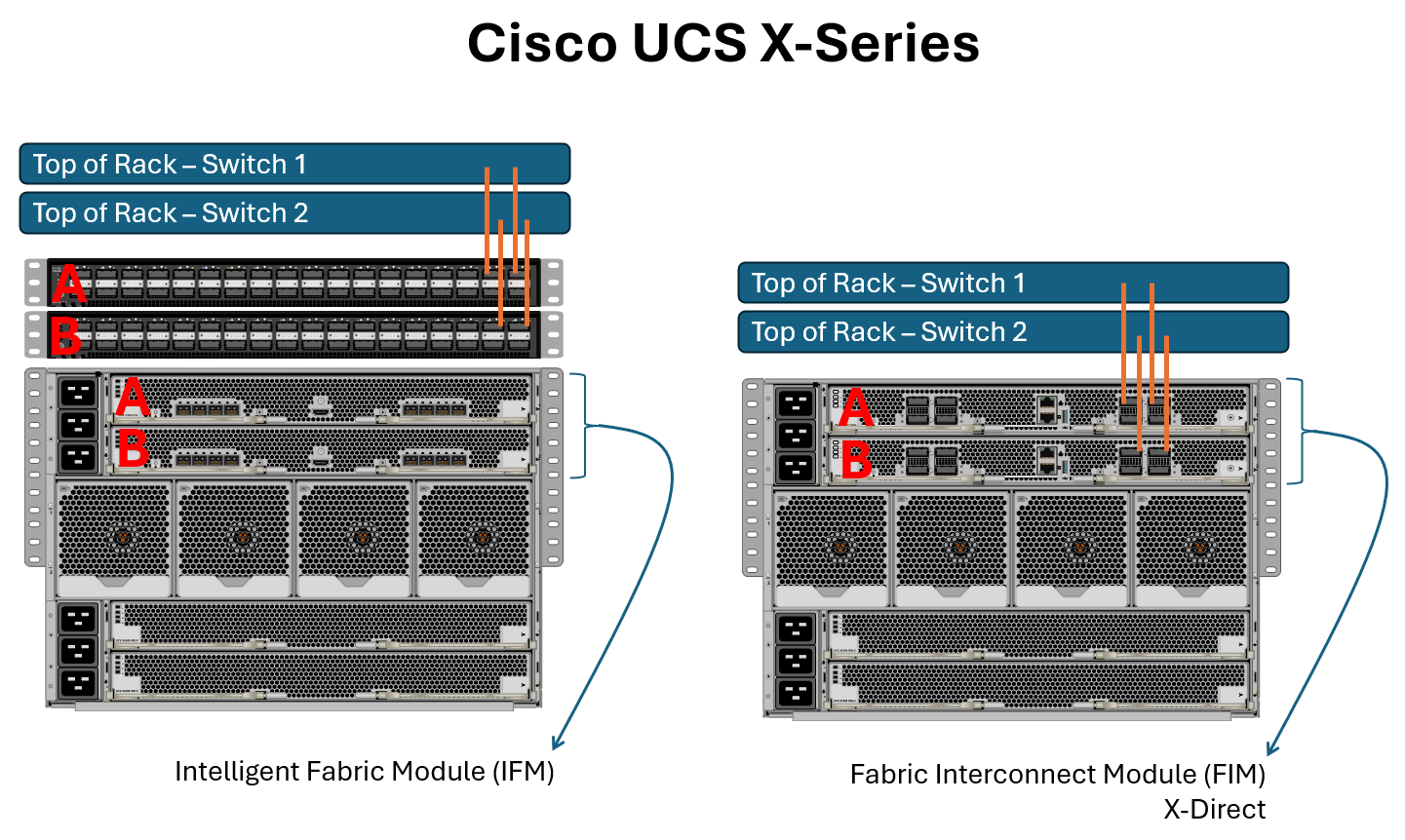
So what does this have to do with Nutanix? First - let's point out what I hope is obvious. Both the IFM and FIM (X-Direct) architectures are fully supported with Nutanix which makes the X-Series platform a great option for both core data center an the edge that provides consistency and predictability. The X-Direct architecture allows for anywhere from a single node Nutanix cluster (if you want to call a single node a cluster) all the way up to a fully populated chassis with 8 nodes, and any variant of Nutanix cluster sizes in between.
In a previous article, I discussed Cisco's support with Nutanix for their latest generation of server, the UCS M8, which introduced Intel's Granite Rapids CPUs as well as AMD Turin CPUs bringing flexibility and choice to customers, but it's worth repeating what was mentioned at the beginning of this post - the ability to mix and match different hardware within a chassis. This flexibility also applies to Nutanix. If a customer needs a 3-node Nutanix cluster at the edge sitting next to a bare-metal workload, everything can go into a single X-Direct chassis.
X-Direct Flexibility
If you're old enough to remember the old windows defrag tool and/or you're a bit particular with how you want things, the last part of the above video should hit home. Because of how Cisco does it's server management, you can move the modular servers around within the chassis to keep things nice and neat without having to reconfigure anything (though Cisco cannot break the laws of physics, to move servers around requires the servers to be powered off).
And if that wasn't enough, yes, this architecture is also supported as part of a FlashStack with Nutanix converged infrastructure. Customer with existing Everpure storage arrays (and soon to be NetApp) can configure these servers without local data drives and connect them to a supported storage array.
What the FIM offers is the ability to plug the storage array directly into the network module (just like you can with an FI). While Nutanix doesn't support the Fibre Channel (FC) protocol, the UCS X-Series platform does. In the video above, the final configuration showed a mix of a Nutanix cluster (IP based solution) and a Windows bare-metal workload. That Windows workload can absolutely be FC based as the FIM converges the different protocols.
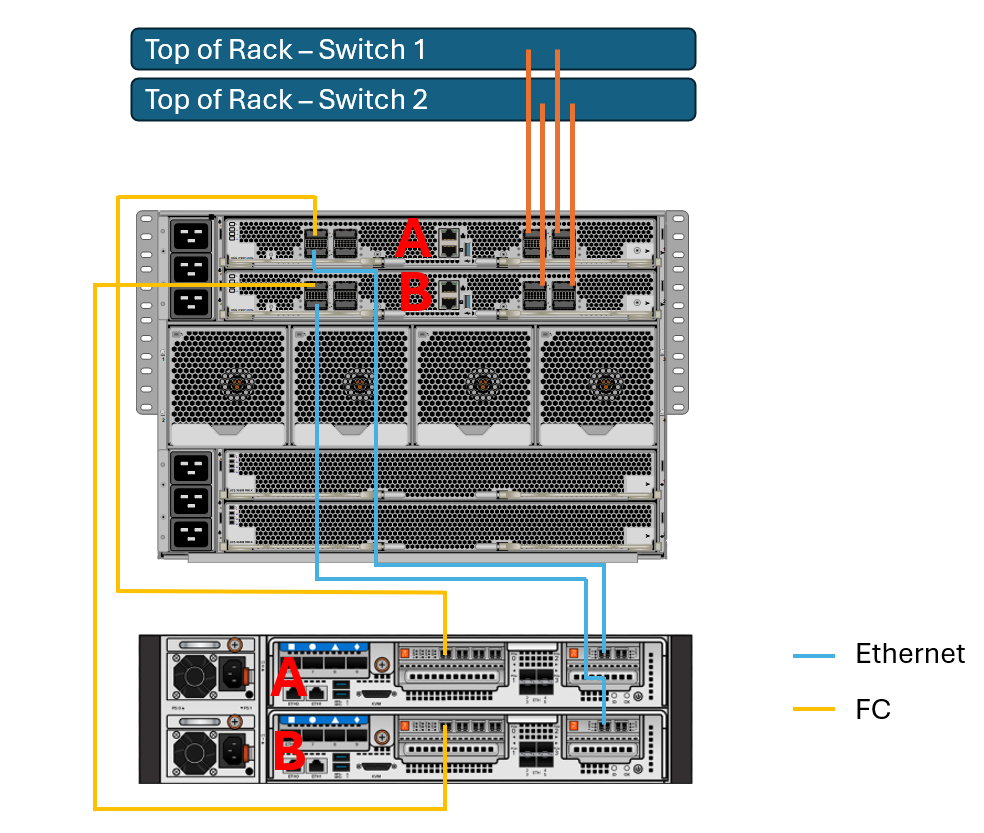
The image above shows an Everpure storage array connected directly to the FIM and providing FC storage to the X-Series chassis for consumption by any workload that supports the protocol. The key takeaway? Edge sites don't need dedicated FC infrastructure or even high-speed ToR switches, but the compute workloads can still leverage the protocols and transfer data at high speeds.
UCS X-Series Direct (X-Direct) is a powerful edge solution for customers but like all things, there's always more that's needed, whether in the form of resources or innovation. Stay tuned for details on a recently released supported architecture that ... drum roll ...